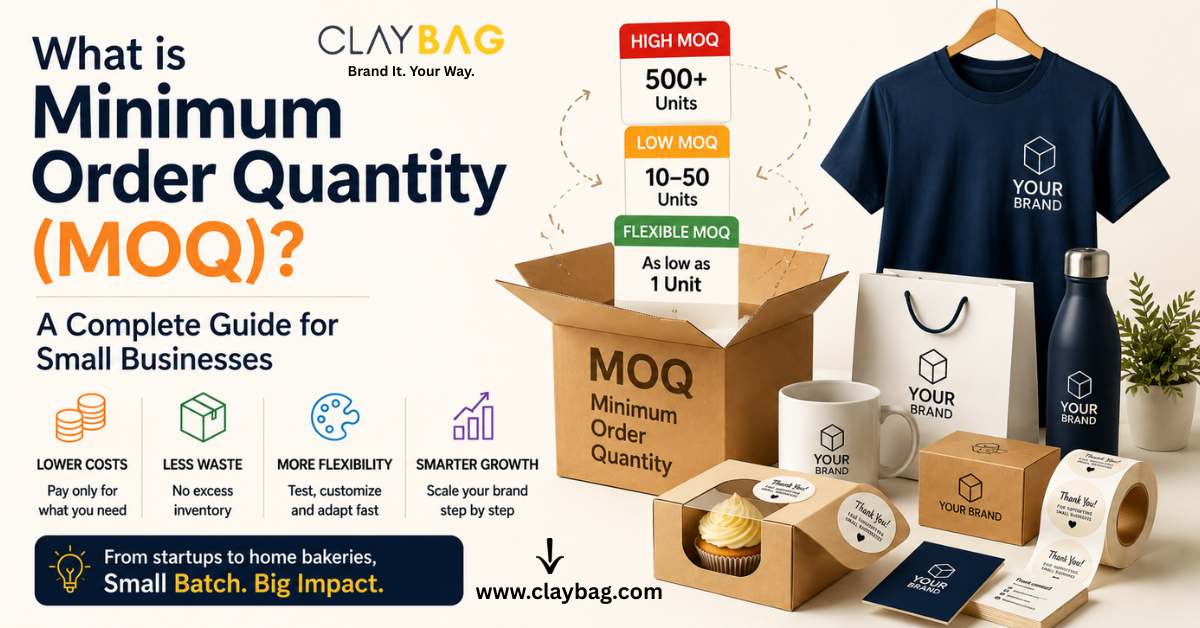
What is Minimum Order Quantity (MOQ)? A Complete Guide for Small Businesses
Ever found the perfect supplier only to hear, “We require a minimum order of 500 units”?. For many small business owners, that single sentence can make or break a deal. Minimum Order Quantity (MOQ) is one of the most important—and often misunderstood—factors in sourcing products, managing inventory, and protecting profit margins. Whether you're launching a new brand, testing a product idea, or scaling your operations, understanding MOQ can save you from costly mistakes and cash-flow nightmares.
In this complete guide, we'll explain what MOQ is, why suppliers set minimum order requirements, and how to find low-MOQ suppliers that help small businesses source products without overstretching their budget.
What is the Minimum Order Quantity (MOQ)?
Minimum Order Quantity (MOQ) is the smallest number of units a supplier or manufacturer requires you to purchase in a single order. MOQs vary by product type and customization method. For example, if the MOQ for a product is 50 units, you cannot place an order for less than that quantity. For buyers, especially startups and small businesses, understanding MOQ is important for budgeting and planning purchases.
Low MOQ vs High MOQ
Choosing between low and high Minimum Order Quantities (MOQs) is a strategic decision that directly impacts a startup’s liquidity, scalability, and profit margins.
Low MOQ allows businesses to order smaller quantities with lower upfront costs and reduced inventory risk, while High MOQ requires larger orders that lower per-unit costs and increase profit margins for businesses with established demand.
Sl. No. | Factor | Low MOQ | High MOQ |
1 | Order Quantity | Small production runs | Large production runs |
2 | Best For | Startups, small businesses, product testing | Established brands with consistent demand |
3 | Upfront Investment | Lower capital requirement | Higher capital requirement |
4 | Cash Flow Impact | Better cash flow flexibility | More cash tied up in inventory |
5 | Inventory Risk | Lower risk of dead stock | Higher risk of excess inventory |
6 | Storage Requirements | Minimal storage needed | Significant storage space required |
7 | Unit Cost | Higher cost per unit | Lower cost per unit |
8 | Profit Margins | Generally lower margins | Potentially higher margins |
9 | Flexibility | High flexibility to adapt to trends | Less flexibility once inventory is purchased |
10 | Customization Options | Often limited | Greater customization opportunities |
11 | Scalability | Suitable for testing and growth stages | Ideal for large-scale operations |
12 | Primary Advantage | Reduced risk and financial commitment | Cost efficiency and economies of scale |
13 | Primary Drawback | Higher per-unit costs | Higher inventory and financial risk |
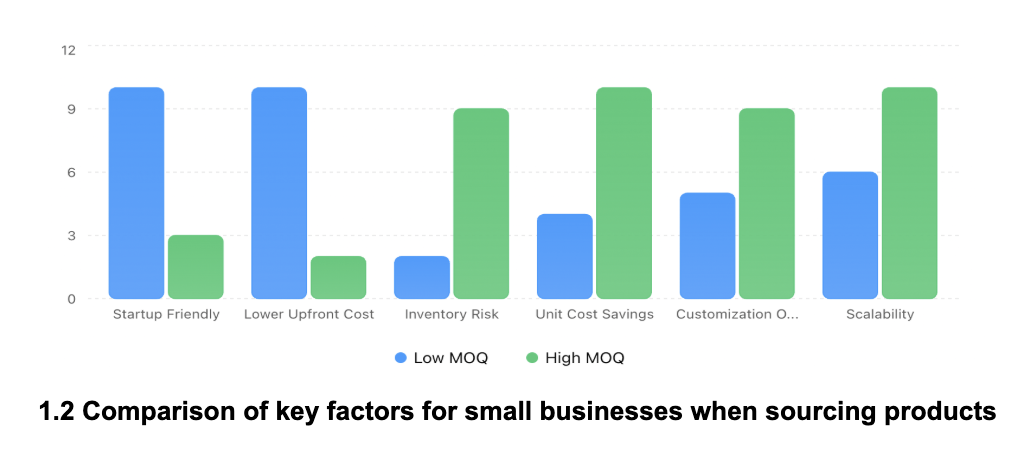
1.1 Comparison of Low MOQ and High MOQ across key sourcing factors
How to Choose the Right MOQ for your Business
Choosing the right MOQ isn’t just a purchasing decision—it’s a growth strategy. And at Claybag, we make sure it works in your favour, not against your cash flow or creativity.
Keep your cash free, not locked in inventory
High MOQs often force brands to invest heavily upfront. With Claybag’s low MOQ advantage, you can start small, test your ideas, and keep your capital free for what really matters—marketing, branding, and growth.
Launch based on real demand, not guesswork
Why overcommit before you know what works? Low MOQ lets you test designs, packaging, and products in the real market, then scale only what performs. No pressure, no excess stock—just smart decisions.
Stay lean, move faster
Big orders can slow you down. With Claybag, you can keep operations flexible, respond quickly to trends, and run limited drops, seasonal campaigns, or custom brand launches without heavy commitments.
Quality you can trust, even at low volumes
Start small, test confidently. Our process is built to deliver consistent quality and reliable timelines—so you can scale with confidence once you’re ready.
Scale when you decide
Once your product gains traction, increasing volume becomes a natural next step—not a forced risk. Claybag grows with your brand, from first sample to full-scale rollout.
With Claybag, MOQ stops being a barrier—and becomes your launch advantage.
The Small Batch Revolution: How ClayBag Helps IT Startups Build Their Brand
Starting an IT company with a small team of 20 people means every decision must be cost-efficient and flexible. Branding is essential, but most vendors operate on High MOQ (Minimum Order Quantity) models—forcing startups to order large volumes they don’t need. This creates cash flow pressure and unnecessary inventory.
ClayBag introduces a practical shift with Low MOQ printing solutions, enabling startups to build strong branding without bulk commitments.
Sl. No. | Category | Essentials |
1 | Business Identity | Business cards, letterheads, presentation folders, company profiles |
2 | Employee Branding | Branded T-shirts, hoodies, ID cards, laptop stickers |
3 | Corporate Gifting | Notebooks, mugs, pens, water bottles |
4 | Event & Marketing | Standees, backdrop banners, brochures, table displays |
5 | Office Branding | Reception signage, wall graphics, branded meeting rooms, desk nameplates |
6 | Experience Kits | Welcome kits for new employees, appreciation kits for clients |
These business essentials help build trust, improve visibility, and make even a small startup look established and credible.
The Problem: High MOQ vs Startup Reality
Traditional vendors focus on High MOQ production—often 100, 500, or even 1,000 units per product. For a startup, this leads to:
High upfront investment
Excess unused inventory
Limited flexibility for design changes
Delayed branding execution
Many startups postpone branding simply because MOQ requirements don’t match their scale.
The Solution: ClayBag’s Low MOQ Advantage
ClayBag is redefining the system with Low MOQ, flexible batch production and pricing advantage. Startups can now order exactly what they need:
20 branded T-shirts instead of 200
25 mugs instead of 500
30 welcome kits instead of bulk stock
Even single-event branding setups
This approach removes the pressure of High MOQ ordering and replaces it with agility and control.
The Small Batch Revolution: How ClayBag Helps Home Bakeries Solve the MOQ Problem
Running a home bakery is all about passion, creativity, and small-scale growth. But when it comes to branding, most suppliers follow High MOQ (Minimum Order Quantity) rules—forcing bakers to order large quantities of packaging and marketing materials that don’t match their actual daily demand.
ClayBag introduces a smarter shift with Low MOQ printing solutions, helping home bakeries build a strong brand identity without unnecessary bulk ordering.
Sl. No. | Category | Essentials |
1 | Brand Identity | Logo design, thank-you cards, price tags, business cards |
2 | Packaging | Cake boxes, cupcake boxes, pastry boxes, stickers, labels |
3 | Product Branding | Custom wrappers, seals, ingredient tags, food labels |
4 | Customer Experience | Thank-you notes, care instructions, discount coupons |
5 | Event & Marketing | Stall banners, standees, menu boards, product display cards |
6 | Social Presence | QR cards linking Instagram/WhatsApp ordering |
These Marketing essentials help home bakeries look professional, build trust, and create a memorable customer experience even at a small scale.
The Problem: High MOQ vs Home Bakery Reality
Traditional vendors operate on High MOQ models—often requiring 500 or 1,000 packaging units per order. For a home baker, this leads to:
Excess unused packaging stock
High upfront investment
Limited ability to experiment with designs
Waste of storage space
Many talented bakers delay branding because bulk ordering doesn’t fit their growth stage.
The Solution: ClayBag’s Low MOQ Advantage
ClayBag solves this with Low MOQ, flexible batch production and pricing advantage, allowing home bakeries to order exactly what they need:
50 custom cake boxes instead of 500
100 stickers instead of 1,000
Small batch packaging for seasonal products
Test runs for new designs without risk
This removes the pressure of High MOQ commitments and gives bakers full control over their branding journey.
Why the Small Batch Revolution Matters
Why should startups pay for 500 units when they only need 50?
ClayBag is redefining branding with low MOQ printing solutions and access to 1,000+ customizable products, allowing businesses to order exactly what they need—whether it's 20 T-shirts, 25 mugs, 30 welcome kits, or a single event backdrop - without sacrificing pricing advantages or budget efficiency.
No excess inventory. No wasted budgets. Just smart, scalable branding that grows with your business.
Because great brands aren't built by ordering more—they're built by ordering smarter.
Are you still paying for bulk orders your business doesn't actually need?
Final Thoughts
MOQ isn't just a number—it's a decision that can impact your cash flow, inventory, and growth. For small businesses, committing to large bulk orders often means spending more than necessary and storing products you may not need right away.
The good news? Branding and printing don't have to come with high MOQ barriers. With flexible, low-MOQ solutions, you can order what your business needs today, stay agile, and scale confidently as you grow. After all, the smartest businesses don't invest in excess inventory—they invest in opportunities.
So, are you building your brand around your business needs, or around your supplier's minimum order requirements?
FAQs on Minimum Order Quantity (MOQ)
What is a Minimum Order Quantity?
add
Minimum Order Quantity (MOQ) is the smallest number of units a supplier or manufacturer requires you to purchase in a single order. MOQs vary by product type and customization method. For example, if the MOQ for a product is 50 units, you cannot place an order for less than that quantity. For buyers, especially startups and small businesses, understanding MOQ is important for budgeting and planning purchases.
How is MOQ calculated?
add
MOQ is calculated based on production costs, raw material requirements, machine setup time, labor, packaging, and supplier profit margins. Manufacturers set a minimum quantity that ensures each order remains cost-effective while covering fixed production expenses and maintaining efficiency across the entire manufacturing process.
What is EOQ and MOQ?
add
MOQ (Minimum Order Quantity) is the smallest quantity a supplier requires per order to make production cost-effective. EOQ (Economic Order Quantity) is a calculation used by businesses to find the ideal order size that minimizes total inventory and ordering costs.
What is a normal MOQ?
add
A normal MOQ depends on the product and supplier. It typically ranges from 50 to 500 units for standard goods, while custom or branded products may start from 10 to 100 units. Low MOQ options are now common, helping startups test products before committing to larger bulk orders.
What does MOQ 30 mean?
add
MOQ 30 means the minimum order quantity required is 30 units. You cannot place an order below this number. For example, if you want to buy a product, you must order at least 30 pieces in one order. It ensures production efficiency and cost-effectiveness for the supplier.